
Meritize partnered with Pivotal Labs to address the skilled-labor gap by helping more people discover vocational training programs and access merit-based funding. Through deep research and iterative design, we built a responsive experience that supports users earlier in their journey, giving them the tools to compare programs, understand location tradeoffs, and confidently move forward. The result: higher enrollment, stronger loan conversion, and a shift to a push-based acquisition model.
Team
1 PM, 1 Eng Manager, 8 Engineers
Responsive web / Mobile / Designing for maps
Focus
Role
Lead Product Designer
Research and problem definition
Context
The U.S. faces a widening skilled-labor shortage, with millions of vocational jobs projected to go unfilled due to lack of awareness, access, and financing. Meritize partnered with Pivotal Labs to build a responsive web app that helps skill-seekers discover training programs – welding, diesel mechanics, medical tech, and more – and secure merit-based funding. Over 4 weeks of research, we uncovered how Meritize was reaching students too late in their journey, and designed a platform that supports them earlier with clearer discovery, location context, and transparent financing options.
The result: increased program enrollment, higher loan conversion, and a shift from a pull to a push customer acquisition model.
Goals
Business Goals
Increase enrollment in vocational training programs
Increase the volume of loan applications
Reach skill-seekers earlier to drive stronger top-of-funnel acquisition
Product Goals
Make it easier to explore programs aligned with specific interests, skills, and location needs
Connect skill-seekers to relevant programs and funding options at the right moment
Create a responsive experience that feels consistent across devices
User research
We spent 4 weeks conducting stakeholder interviews, user interviews, and collecting data on existing engagement to understand the landscape of this problem, the business, and opportunities for impact. I worked with my PMs to prioritize the problems we discovered based on how often we heard the problem and how painful we perceived it to be for our users. We set out to understand:
When skill-seekers begin researching programs
What motivates or discourages them
What causes them to abandon the process
Where Meritize was appearing too late in their journey
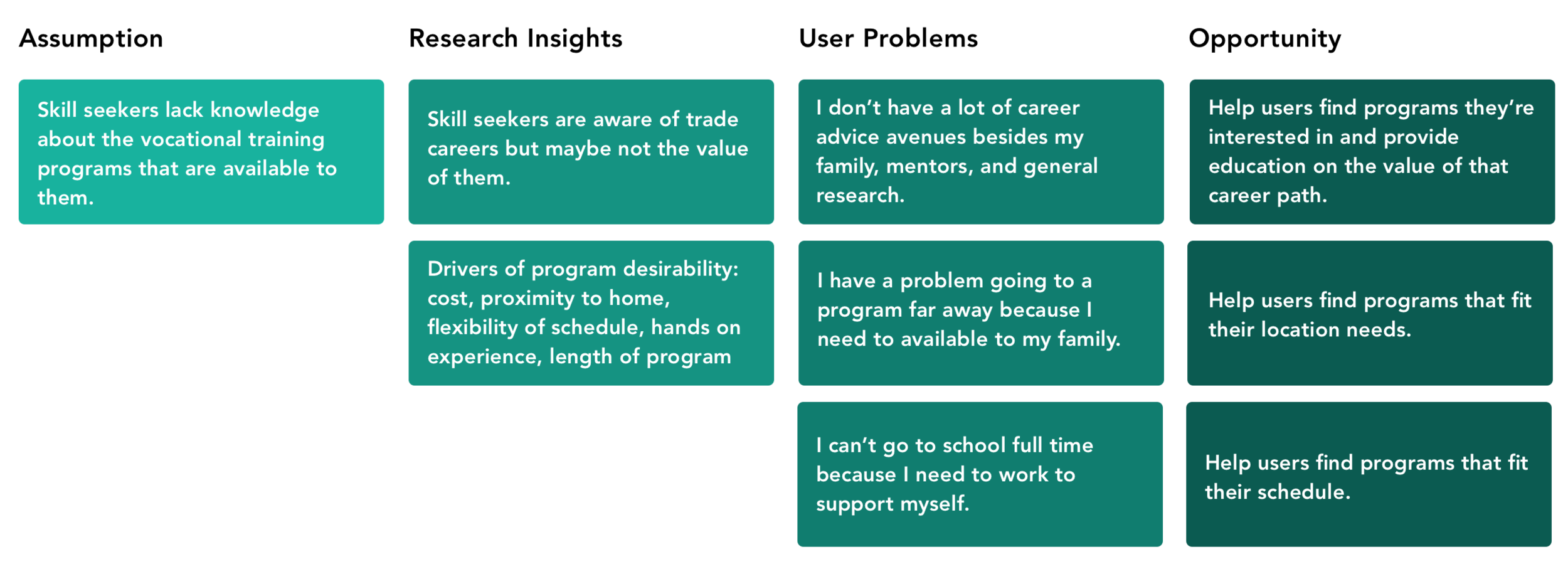
Key insights
01
Meritize reached users too late
Most engagement happened only once students had already chosen a school — missing earlier discovery moments.
02
Location was central to decision-making
Users needed to understand distance and travel constraints to evaluate program fit.
04
Skill-seekers needed help comparing programs.
Filtering by program type, duration, modality, and location was key to building confidence.
03
Program selection always came before financing.
Pushing loan applications early eroded trust and didn’t match user intent.
Opportunity
By supporting discovery earlier, before users committed to a single school, Meritize could:
Help users find the right program, not just the closest referral
Increase trust and transparency around funding
Grow the top of funnel for program enrollment and loans
Shift from a referral-based “pull” model to a direct “push” model

Design
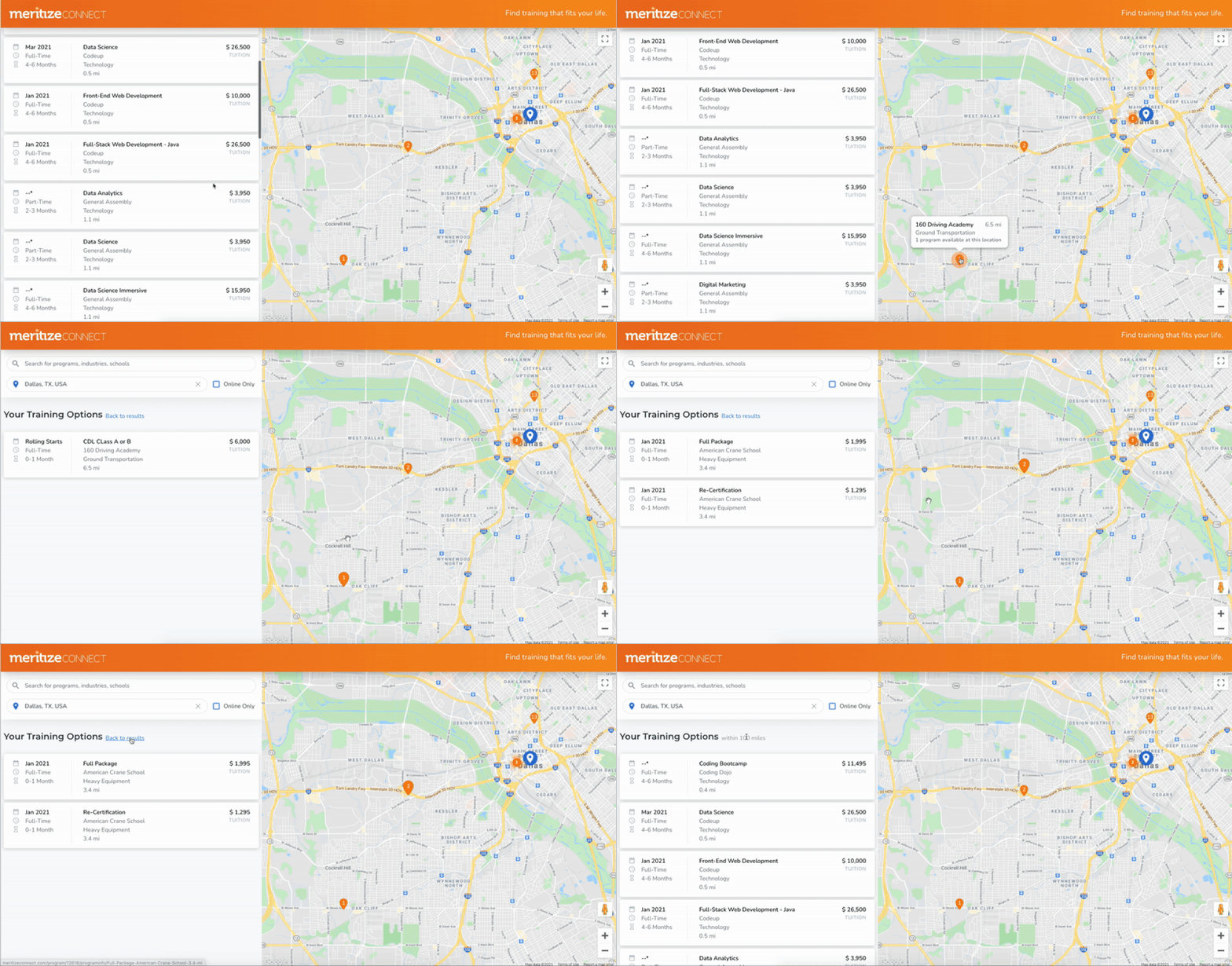
Location-forward discovery
Skill-seekers consistently asked: “How far is this from me?” Distance often determined program feasibility, so we integrated Google Maps to give users spatial context and a more intuitive way to compare programs.
Key Interaction Challenges Solved
Tapping a map pin reveals all programs offered at that location
Clear mobile translation without gesture conflicts (scroll vs pan)
Handling programs that share the same physical address
Providing both map and list views depending on user preference
This gave users the geographic awareness they needed without overwhelming the experience.
Mobile experience
Because many users browse vocational programs on their phones, the mobile experience needed to be just as strong — but not a compressed version of desktop.
Key design cecisions:
Maps became an optional toggle to reduce gesture ambiguity
Programs were displayed as a mileage-ordered list for quick scanning
Shared components across breakpoints reduced engineering effort and improved familiarity
The result is a mobile flow that feels intentional and native to the device.

Growth design
Stakeholders initially pushed for a persistent “Apply for a Loan” CTA in the global header.
In testing, users found this aggressive and misaligned — financing wasn’t their next step after browsing programs. I addressed this tension by doing the following:
Moved the financing CTA to the program details page
Reframed the CTA to “Get Your Rate,” matching user mental models
Ensured the funnel supported natural user flow without sacrificing business goals
This both improved trust and supported stronger conversion.

Outcomes
76 loan applications submitted in the first two weeks post-launch
62.3% conversion rate
Increased enrollment in vocational training programs
Increased access to merit-based funding
Fundamental shift from a pull model (school referrals) to a push model (direct acquisition)
Retro
This project reinforced the power of aligning business outcomes with real user behavior. By meeting skill-seekers earlier in their journey and designing around how they naturally evaluate programs we helped Meritize unlock clarity, trust, and a far more effective customer acquisition strategy.