
I partnered with the SpaceForce and a cross-functional team at Pivotal Labs to transform how warfighters request support from space assets. Previously, these Space Support Requests were handled through emailed Word documents and spreadsheets: a slow, error-prone process with little visibility for anyone involved. Through user research, service blueprinting, and continuous iteration, I redesigned this workflow into a modern web application with clear request cards, an intuitive workflow model, and a scalable action sidebar. The result was a dramatic reduction in processing time (from 3 days to 10 minutes) and a centralized, transparent experience that helped warfighters quickly understand the status of their missions.
Team
1 PM, 1 Eng Manager, 8 Engineers
Enterprise SaaS / Security
Focus
Role
Lead Product Designer
Research and problem definition
Context
Space Support Requests (SSRs) are the avenue through which warfighters around the world request support from space assets (satellites, rockets, etc). These requests are processed through the CSpOC, who then task them out to the units that operate those assets.
The SpaceForce collaborated with Pivotal Labs to ship a product for warfighters to easily request support from space assets.

User research
The current workflow is: Warfighters around the world submitted Word document forms via email and coordinators manually track those requests in Excel, then email tasking instructions to assignees. To understand the end-to-end process and its breakdowns, I led a service blueprint workshop with stakeholders across roles and time zones.

Key pain points
Error-prone and time-consuming: Manual data entry created frequent inaccuracies and slowed down time-critical missions.
No visibility: Requesters had no way to know the real-time status of their support request.
Hard-to-use form: The Word doc was dense, poorly structured, and often submitted incomplete.
Constant back-and-forth: Missing information caused long email chains, often across different time zones.
Tribal knowledge: Coordinators relied on old emails or memory to determine who to task.
Fragmented communication: All updates were scattered across inboxes, spreadsheets, and documents.
This discovery phase gave us a clear mandate: reduce friction, increase clarity, and centralize everything.
Designing the solution
Card layout
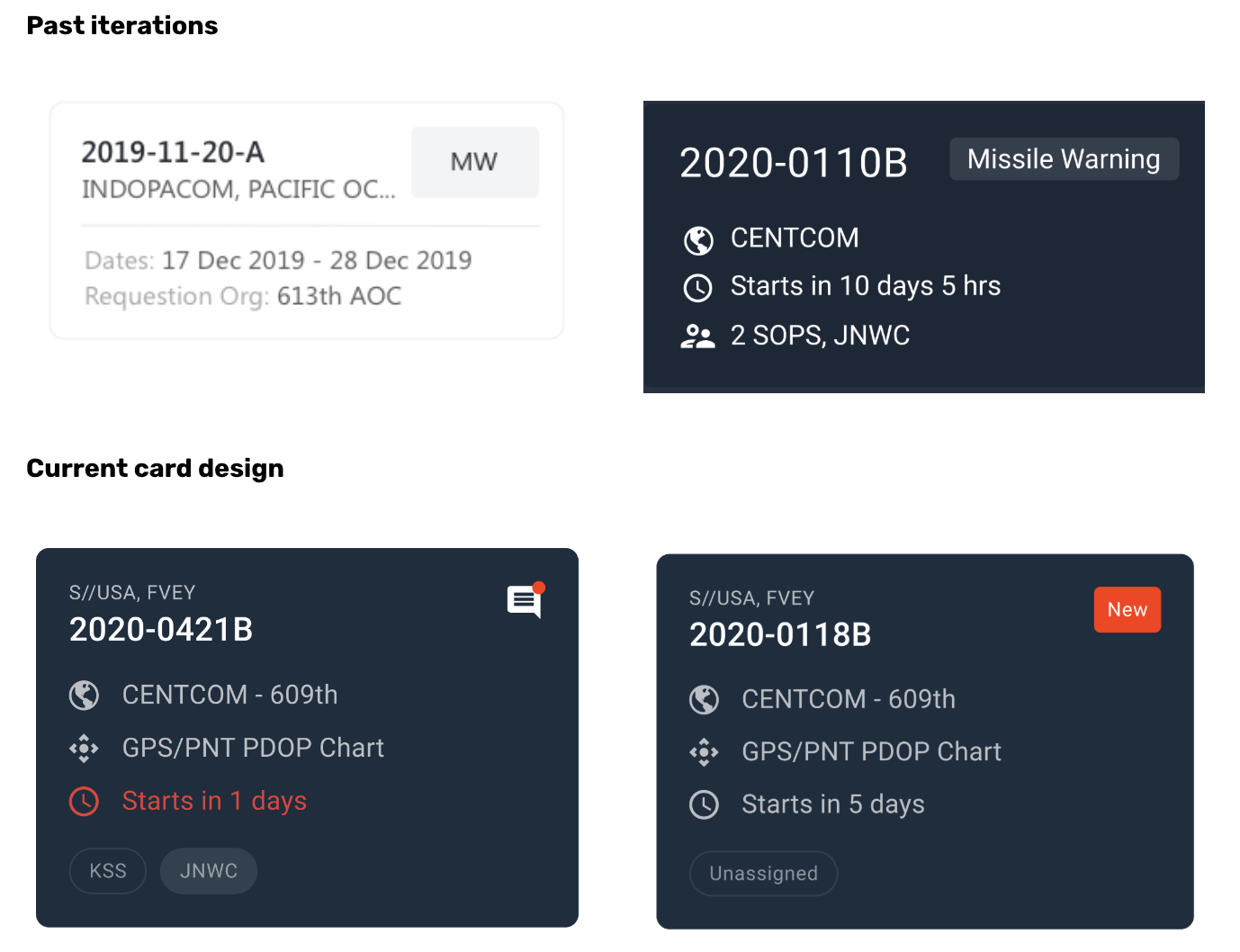
I introduced a card-based design that allowed coordinators to quickly scan large volumes of requests.
Over a year of iteration and user feedback, I refined: the hierarchy of fields, readable time and location metadata, priority signals, and visual indicators for status and actions
The final card layout balanced density with clarity and gave coordinators everything they needed at a glance.
Kanban style workflow
I initially tested a much more rigid kanban-style flow for requests, but field testing revealed that users needed far more flexibility.
Based on this insight, I designed a hybrid model that clearly distinguished between: requests needing action vs requests currently in execution
This approach gave users autonomy while preserving enough structure to maintain clarity and accountability.

Scalable action sidebar
On each request's detail page, I created a right-hand action sidebar that housed all possible actions (commenting, adding files, extending requests, tasking, etc.) in a consistent modal pattern.
This design became the backbone of new features we added later — enabling fast, predictable expansion of the system without creating UI sprawl.

Outcomes
Quantitative impact
Processing time reduced from 3 days → 10 minutes
Coordinators could triage, assign, and communicate rapidly: a massive improvement for time-sensitive missions.
Qualitative impact
Centralized source of truth: All activity, files, and communication lived in one place.
Real-time visibility: Warfighters could see the exact status of their request at any moment.
Reduced errors: Clearer forms and guided workflow reduced missing or incorrect fields.
Scalable foundation: The action sidebar and information architecture supported ongoing feature growth.
Looking back
This project taught me the value of grounding complex workflows in clear mental models and using iterative research to guide every decision. Working with the SpaceForce was a unique challenge but designing a tool that directly supports mission-critical work was incredibly rewarding.